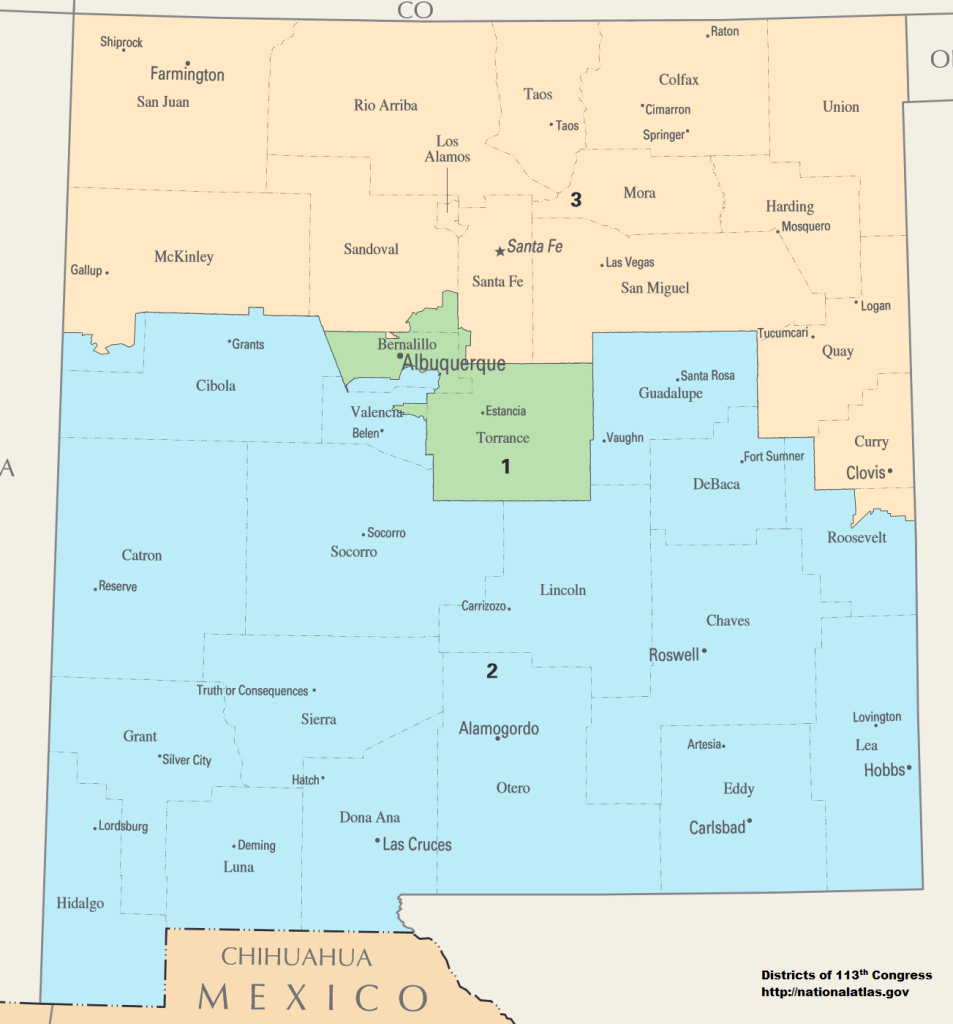
On April 6, Governor Michelle Lujan Grisham signed Senate Bill 304, which creates a citizen redistricting commission that will propose new legislative and congressional districts.
While citizen redistricting commissions have become more popular over the last ten years, some are fully independent from the state legislature and some aren’t.
Many argue that the citizen/independent commissions that cannot be meddled with by legislators restore the public’s confidence in the political process of redrawing congressional maps.
Yet, New Mexico’s commission won’t be fully independent, as the state legislature can amend any map as they see fit, an authority granted to the legislature by the state Constitution.
Nevertheless, SB 304 is considered to be a much needed step to take the politics out of the redistricting process.
The politics of redistricting played out in 2010, when both the Democratic Legislature and GOP Gov. Susana Martinez failed to reach an agreement on an election map.
This caused a number of headaches, as state courts had to intervene and create the current congressional maps, and the disagreement cost taxpayers $8 million dollars in legal fees.
After the bill passed on a 64-2 vote in the House, it passed the Senate, as the senators concurred with the House amendments, sending the bill to Lujan Grisham.
Sen. Brenda McKenna, D-Corrales, who sponsored the bill, said after the bills signing, “With the signing of this legislation by the governor today, New Mexicans will finally have a constitutional, fair, and transparent redistricting process.”
Speaker Brian Egolf, D-Santa Fe, also applauded the bill after it’s signing, saying, “With the governor’s signature today, we now have a process that ensures inclusivity of our state’s Native and communities of color, and that protects their voices in our democratic process.”
“The people of New Mexico deserve a fair, open, and constitutional redistricting process that takes into account the diversity of our great state,” added Egolf.
Rep. Greg Nibert, R-Roswell, said that “It’s been a long road coming to this point,” and Sen. Mark Moores, R-Albuquerque, stated that “The passage of this bill may be one of the most important things we did as a Legislature this session.”
The bill creates a seven-member citizen committee that would draft maps for the state House of Representatives, the state Senate, the three Congressional Districts and the Public Education Commission.
Four of the members would be selected by the majority and minority leadership in the House and Senate, two would be selected by the The State Ethics Commission and they cannot be registered to either the Republican or Democrat party.
The chairman of the committee also must either be a retired state Supreme Court justice or appeals court judge.
Other provisions that exist within the bill are that the committee cannot consider party registration data in crafting the proposed boundaries, and the panel couldn’t consider the voting addresses of candidates or incumbents, except to avoid pairing of incumbents, if possible.
Many advocacy groups are pleased with the final bill, such as Kathleen Burke, project director of Fair Districts for New Mexico, who said, “New Mexico takes a giant leap toward modern redistricting and a leap away from the post colonial gerrymandering of the past.”
Others, such as Dick Mason who also works for Fair Districts for New Mexico, said that “The passage of SB 304 is just the beginning of the end.”
“We have to remain vigilant throughout the whole process to assure that we deliver fair district maps that will make New Mexico proud,.” Mason said.
The state has until July 1 to create the commission and the body must send proposals to the legislature by the end of October.
In an effort to also bolster transparency, the commission must hold at least six meetings that are accessible online and allow for public participation and map proposals must also be made available for public comment.
“This will be the first time that a citizen group will drive the process instead of lawmakers,.” Ed Chavez, co-chair of the state’s Redistricting Task Force and retired chief justice of the state Supreme Court also said.
“The public’s participation will help ensure that, in the long-term, voters have a fair and equal opportunity to select representatives of their choice,.” Chavez said.
Once the maps are created by the commision, the legislature would go into a special session to consider the maps and vote on which ones to send to Lujan Grisham for final approval and adoption.
Spencer Butler can be contacted at sb751094@gmail.com or on Twitter @SpencerButler48
 ABQSportsReporter