A review by: Spencer Butler
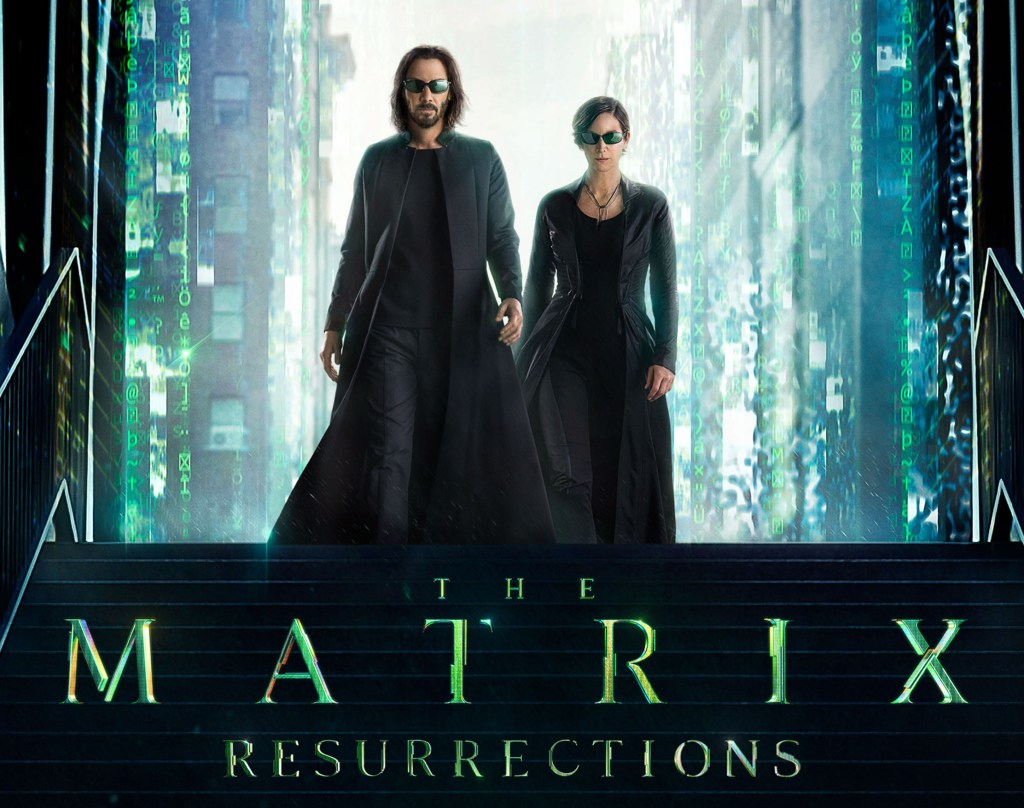
Well, this is certainly a post that I didn’t expect to write while I was in college… nor did I expect to write about a sequel to one of my favorite franchises in cinema.
The original Matrix is my favorite movie ever made, and the trilogy of films is in my favorite three-part series.
Yet I wasn’t really cognizant of my surroundings when these films came out, as I hadn’t been born, yet, when The Matrix released in 1999, and was only 4 years old when both Reloaded, and Revolutions released in 2003.
So, when the rumors and speculation began that not only was the Matrix returning, but that Keanu Reves would 9return in a sequel film to the trilogy, my hype was through the roof.
I was finally going to see my favorite franchise on the big screen, and hopefully see the franchise I adore so much return to prominence.
I would love to tell you that the latter did happen, but I don’t think that this will occur in this reality. This film is proving to be one of the most divisive films of the year, with factions spilling out and sides being taken (much like Star Wars, Ghostbusters, Robocop, and others).
Some believe that Resurrections is an afront to the original trilogy, while others believe that it is a worthy sequel that continues the franchise and opens the door of possibilities.
I seem to fall in between these two groups.
While I thoroughly enjoyed the film and think that it was a worthy successor to the originals, I do have some issues with the film and think it could have used some slight adjustments that would have helped it stand out.
The first couple of sections will contain no spoilers, and once I go into elements of the film that are integral to the plot, I will let you know.
The Prospect of Return
I would like to go over the positives that I observed when watching the film first, followed by the criticisms that I do have.
All of the returning actors, as well as the newcomers to the series are fantastic. Keanu and Carrie-Anne Moss return and have brilliant chemistry when they are on screen together, and Jada Pinkett Smith’s return as Niobe was also fantastic.
Newcomers Yahya Abdul-Mateen II, Jessica Henwick, Jonathan Groff, and Neil Patrick Harris all play their roles to perfection, and the rest of the cast also do a fantastic job.
The visual effects are also a standout, as in most Matrix films, and the shot quality is often great, with lots of color and vibrant lighting that isn’t present in the original trilogy.
I for one also enjoyed the main plot of the film, the quintessential love story that was never the focus of the first three Matrix movies and thought that it was an interesting take to continue the series, but I can also see why many may not like the direction.
Trouble Around Every Corner
Yet there are story problems that do exist within the film, and many plot threads that are left either underdeveloped or not resolved when the film ends. While this isn’t new to the franchise, there is a lack of context for when this movie is taking place.
It feels as if this film is a set up film for other stories within the Matrix, and while this is a good idea in concept, in practice it leaves the viewer confused and mystified as to why this even needs to exist.
While this is a grip that I do have, this isn’t the major complaint that I have with the film.
The two major points of contention that I have come from the fight scenes and the music that is present within the film.
It isn’t as if the fighting within the film is bad, in my view, but the camera is way to close to the action that it takes away from the choreography that is present; and as well the fighting doesn’t seem to really matter and can feel like it’s just there to fit a specific requirement that was laid out.
The music is weak, say for the opening and a spattering of tracks. The music doesn’t have the vibe that the original soundtrack created by Don Davis had, and it feels like generic action movie pieces that are easily forgotten and that have no impact.
I personally wish that there was more cyberpunk or rock music within the film, and I honestly think that the music being so lackluster holds the film back.
Through the Looking Glass
As for the meta nature of the dialogue, I personally had no problem with it. But I like films that do take risks with the dialogue rather than sticking with a basic formula.
Sure, a remake of the Matrix or a soft reboot would have done better, but it would’ve suffered the same fate that other reboots that follow their originals have: that they are boing, dull cash grabs that flame out fast (see Total Recall, Robocop, Ghostbusters, The Mummy, Point Break, Nightmare On Elm Street, Red Dawn, Piranha 3D, Child’s Play, Fantastic Four, and Conan The Barbarian among a host of other terrible remakes: https://www.buzznet.com/2019/12/worst-reboots-and-remakes-from-the-2010s/?view-all&chrome=1)
I find this film to be The Man of Steel, the reboot of Superman that was the basis of DC’s entire cinematic universe that was so divisive it toppled the entire house of cards before it could get off the ground, and while I personally agree with this sentiment, there are many that don’t.
The difference, for myself, is that I am on the other side of the argument for this film in that I enjoy and like Resurrections as much as Reloaded and more that Revolutions.
I guess that can be due to the expectations that I had when going into the film, that it wasn’t going to be the 1999 Matrix film that redefined cinema but more in line with Reloaded and Revolutions.
Overall, I think it’s a 7/10 or 6.5/10 film that benefits from the cast but is weakened by the wonky camera work that some scenes have, and the plot holes that do exist within the story.
Warning! Spoilers for the film are next, if you don’t wish to know more, then stop following the White Rabbit…
But if you wish to go further, then I can show you how deep the rabbit hole goes.
Here we go.
This is where I can air out more of my gripes and theories as to why certain things are the way that they are.
- Agents don’t really exist, outside the opening 15 minutes, and instead the concept of the agent is now present in every program plugged into the Matrix. While this is a better concept than the original agent’s that had to morph into every human plugged into the system, the lack of agents does leave a hole in the cast of villains.
- Morpheus is played by Yahya Abdul-Mateen II, and not Laurence Fishburne. This new Morpheus is also briefly Agent Smith, who is stuck in a modal created by Neo and that is a recreation of the original opening to the 1999 Matrix. He is freed by Bugs and learns about Morpheus’ past. It is later revealed by Niobe that the Morpheus of the previous films is dead and died when Zion was destroyed. This is a slight retcon from the established lore of the series that saw Morpheus die within the Matrix in the events of The Matrix Online. This seems to be setup for a film about what happened after the events of The Matrix Revolutions.
- Niobe is now the general of IO, the new home of the remaining humans. Built with the help of machines and programs, who can now enter the “real” world, it is revealed that after Neo entered the machine city, the definition of who’s side a program could be on was changed.
- It is also revealed that after Neo entered the machine city, a war between machines broke out. My guess is that this will be explored in a different film, but it seems as if the machines were fighting over what The Matrix was to become. Let me explain. In the original trilogy, a program called the Architect controlled the Matrix, a program that is defined as humanity in the late 1990’s that keeps them trapped and etc. etc. ETC. [if you don’t know all of this already then you should just look it up.] Yet the Architect is not present in this film and is instead replaced with the Analyst, a program that was apparently present when Neo died in Revolutions. He saw an opportunity to change the Matrix and most likely overthrew the Architect to become the head operator. The difference is that while the Architect based the Matrix on facts, the Analyst based this version on feelings. It seems as if the Analyst forced his way into power…
- How Neo and Trinity are brought back is interesting. The Analyst initially revived Neo to study “The One”. Later he revives Trinity: “Through countless iterations he found out that, while when they worked together, they overpowered the system, but if Neo and Trinity are kept close to each other but without making contact, the other humans within the Matrix would better accept the simulation and produce more energy for the machines.” Again, emotions trump logic, a point that is constantly made throughout the film.
- Some other points to be made; 1. It has been 60 years since Revolutions, yet Neo and Trinity have only aged 20 years due to their resurrection. 2. The Oracle disappeared and doesn’t appear in the film; however, Sati does appear with a machine in the “real world” called Kujaku. My father and I are wondering if Kujaku is the Oracle. After all, one of the points of the original films was that the oracle was being hunted down constantly. Merely an idea that we have. 3. Agent Smith is more of an anti-hero in this version, as while his goals don’t align with Neo’s, they don’t align with the Analyst’s either. 4. The Merovingian and the exiles appear, and while The Merovingian doesn’t really do much, it does mean that a number of other programs from the previous films might still be running around [such as Seraph]. 5. Their seems to be mention of the “suits”, or programs that control the Analyst. One must wonder if there is a program that controls his actions.
This is all that I have to add. I enjoyed my time back in The Matrix, though I can also understand why others didn’t.
I think this tweet sums up my thoughts well: https://twitter.com/WajahatAli/status/1474529342294220801
And if you would like to read some more, then please read this: https://www.theringer.com/movies/2021/12/23/22850565/matrix-revolutions-sequel-reboot-meta
Goodbye, for now…
 ABQSportsReporter